 A first course on differential equations, aimed at engineering
students. The prerequisite for the course is the basic calculus sequence.
This free online book (OER more formally)
should be usable as a stand-alone
textbook or as a companion to a course using another book such as
Edwards and Penney,
Differential Equations and Boundary Value Problems:
Computing and Modeling
or Boyce and DiPrima,
Elementary Differential Equations and Boundary Value Problems
(section correspondence to these two is given).
I developed and used this book to teach Math
286/285 at the University of Illinois at Urbana-Champaign
(one is a
4-day-a-week, the other a 3-day-a-week semester-long course).
I also used it for
Math 20D at the University of California, San Diego
(a 3-day-a-week quarter-long course)
and Math 2233 (semester-long introduction) and Math 4233 (an upper-division
continuation of 2233) at
Oklahoma State University.
There is enough material to run
a two-semester sequence depending on lecturer speed.
A first course on differential equations, aimed at engineering
students. The prerequisite for the course is the basic calculus sequence.
This free online book (OER more formally)
should be usable as a stand-alone
textbook or as a companion to a course using another book such as
Edwards and Penney,
Differential Equations and Boundary Value Problems:
Computing and Modeling
or Boyce and DiPrima,
Elementary Differential Equations and Boundary Value Problems
(section correspondence to these two is given).
I developed and used this book to teach Math
286/285 at the University of Illinois at Urbana-Champaign
(one is a
4-day-a-week, the other a 3-day-a-week semester-long course).
I also used it for
Math 20D at the University of California, San Diego
(a 3-day-a-week quarter-long course)
and Math 2233 (semester-long introduction) and Math 4233 (an upper-division
continuation of 2233) at
Oklahoma State University.
There is enough material to run
a two-semester sequence depending on lecturer speed.
The aim is to provide a low cost, redistributable, not overly long, high-quality textbook that students will keep rather than selling back after the semester is over. Even if the students throw it out or sell it, they can always look it up on the net again. Or perhaps today's students mostly use online sources to begin with. (Chances are your students might be using this book even if you are requiring another one.) You are free to have a local bookstore or copy store make and sell copies for your students. See below about the license.
Another aim of the book is to allow modification and customization for a specific purpose if necessary. If you do modify the book, mark it prominently as such to avoid confusion. This aspect is important for the longevity of the book as well. The book can be updated, fixed, and modified even if I happen to drop off the face of the earth. You do not have to depend on any publisher being interested as with traditional textbooks.
Finally, errata are fixed promptly. No need to wait several years for a new edition. Every once in a while I may make some major addition and a new major version (edition), and then in between as errata are fixed I make minor version updates (like a corrected printing) usually once or twice a year, depending on the errata discovered. Exercise, chapter, and section numbers are preserved as much as humanly possible. What's added is added at the end with new numbers, so the book is generally compatible even if students (or the instructor) have an older printed copy. The minor updates are totally interchangeable and have very minimal changes, essentially nothing new.
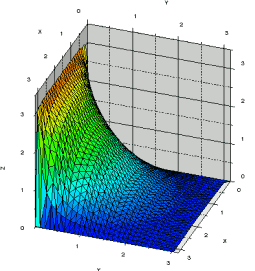
The graphs in the book were created using the Genius software.
MAA (Mathematical Association of America) published a
review of the book
(they looked at the December 2012 edition;
quite a bit of stuff has happened since then).
Introduction
There are 747 exercises throughout the book,
251 of which have a solution in the back
(those numbered 101 and above).
A few exercises are within the section text, but most are in their
own subsection at the end of every section. Each section should have enough exercises
for homework even for a demanding class.
Please let me know at
if you find any typos or have corrections, extra exercises or material, or any
other comments.
The book was
used, or is being used, at over a hundred
universities and colleges including Dartmouth College, University of Tennessee, University of Toledo,
University of British Columbia, University of California at Irvine,
University of Kentucky, University of Hawaii, and
many others.
The book has been selected as an Approved Textbook
in the American Institute of Mathematics Open
Textbook Initiative.
See a list of classroom adoptions for more details.
If you use the book for teaching a course,
do let me know ()!
Download the book as PDF
Version 6 added Appendix A (linear algebra), and sections 1.9 and 6.5 (PDEs).
Look at the
errata in the current
revision (if any).
Look at the change log to see what changed in
the latest version.
I get a bit of money when you buy these (depending on where exactly they are
bought). Probably enough to buy
me a coffee, so by buying a copy you will support this project. You will also
save your toner cartridge.
The difference between these two versions is
essentially just the cover art. I have seen printed versions from both and
they are both good quality.
Buy
a copy on Amazon for $25.00.
It probably ships faster (than lulu), and it has a spiffier cover.
This copy is
the May 15th, 2026 revision (version 6.11).
Buy a
paperback
copy at lulu.com for $25.00.
You can also buy a larger (letter size)
coil-bound
copy at lulu.com for $27.39.
This copy is
the May 18th, 2026 revision (version 6.11).
No ISBN for these guys.
Browse the
web (HTML) version
of the book.
The web version should be easier to browse and read on various electronic devices,
and it should be fully accessible
as per the Web Content Accessibility Guidelines (WCAG).
This version uses a very slightly modified
PreTeXt system for the
conversion.
You should use the PDF version for printing as you will
get a much better quality printout.
Search this site, including the web version (Google might put some ads in
your search, unfortunately, I can't get rid of that). There is a more specialized
search inside the web version that might work better for you.
Sage is a very comprehensive
free mathematical software.
Here we collect some relevant Sage worksheets and demonstrations you can play around with.
Some simply use Sage to give a demonstration,
but many are worksheets where you can edit the code and use it to experiment.
The code here runs on the free SageCell server; you cannot save your work and there are
other limitations. If you want to use Sage without installing
but still want to be able to save your work and do more complicated
computations, consider CoCalc, which is a
cloud based Sage installation.
Using Sage for ODE: Plot functions, solve ODEs numerically
and symbolically.
Section 1.2: Plot slope fields and solutions given an initial condition.
Section 1.3: Plot implicit solutions.
Section 1.6: Several interactive demos on autonomous equations in one variable.
Section 1.7: An interactive demo of Euler's method.
Section 1.8: Plot level sets of potential functions;
implicit solutions to exact equations.
Section 1.9: Plotting the characteristics, and the solutions
to first order linear PDE.
Section 2.3: Using Sage to solve the characteristic polynomials.
Section 2.4: Several animations of mechanical vibrations.
Section 2.6: Interactive demo of forced oscillations and resonance.
Section 3.1: Using Sage to solve systems of ODE and plotting vector fields.
Section 3.2: Using Sage for solving linear systems and basic matrix operations.
Section 3.5: Interactive demos of two-dimensional autonomous systems.
Section 3.6: A second order system (carts connected with springs) interactive demo.
I am building a set of slides and a YouTube course. You may want to watch
it full-screen.
The course is not yet complete, new lectures are added as time allows.
The Slides: (also incomplete so far) as PDFs. Some of the slides have been slightly
improved since I recorded the lectures, so they might not match 100%.
WeBWorK:
I put together a set of problems for WeBWorK with 497 problems.
Download the set
as a tgz file
(or see the GitHub repository).
Just upload the tgz file to your WeBWorK course,
and it will automatically unpack in your templates directory
and create a directory called diffyqs-webwork.
There are predefined problem sets for the relevant sections,
as "def" files, that you can "import" as new homework.
There are currently problems for chapters 0, 1, 2, 3, 4, 6, 7, 8, A.
The problems also have links to the web version of the book for easy reference.
The majority of the problems come from OPL (Open Problem Library), but have been
edited to fit the course or generally improved, some have been edited or
changed quite heavily, and quite a few new problems were added.
There should be enough
problems for most types of courses, but let me know if anything is missing, or
if there are other OPL problems that you think I should include.
Edfinity:
Essentially the same set of problems, based on a slightly older version of my set, is
available on Edfinity.
Edfinity may be a bit easier to use than WeBWorK, you don't have to install
anything, it is hosted by Edfinity, and is student-paid.
Unfortunately, the Edfinity set seems to have diverged from my version over time,
and for example, these do not have the book links.
You can still add other OPL problems into your class,
create your own, or if you prefer my set, you can download the set above and
paste in my set as webwork problems.
Let me know () if you use the problem set. I'm also interested to know any
feedback on what's missing, what should be changed, etc.
I set up a discussion forum for the book on
Google
Groups. I expect this to be a low volume forum, but it might be a good
place for instructors to interact, where to post extra material, ask a question
of the other instructors, discuss the WeBWorK problems, and I will send
announcements there, such as when a new version is out.
I put together all the figures as PDFs
as one big zip file. This should make it easier to create computer slides using
the figures, without messing with the source tarball. If a figure
appears in multiple places, its filename only refers to the first such place.
There's tons of extra materials (including longer modeling projects) at
SIMIODE.
The IODE software is a
free software package for experimenting with basic ODEs developed at University
of Illinois specifically for teaching this kind of course.
IODE works both with Matlab (proprietary) and Octave (free, but no GUI).
The IODE website has several
extra projects for the students to work through as homework.
Adam Spiegler of the University of Colorado Denver has put together
a
suite of Jupyter notebooks that are linked to various sections in
this book and also in Trench's book.
Ray MacAllister has put together musical versions of the Poincaré sections
of the Duffing equation \(x'' + 0.05x' + x^3 = 8 \cos(t)\) with initial
values \(x(0)=2, y(0)=x'(0)=3\), which is the left-hand plot on
Figure 8.14
in the book. The \(t\) ranges from 0 to 3000 played at regular intervals of \(2\pi\),
\(x\) is the orchestra and
\(y\) is the piano. Here is an mp3 of the result.
There is also an arpeggio version.
Prof. Martin Weilandt of Universidade
de Santa Catarina has prepared a partial Portuguese translation. See his class page.
Prof. Charles Bergeron has created a modified version of the book. The title is
Differential Equations:
Including Linear Algebra Topics And Computer-Aided Problem-Solving. This
book removes some topics (e.g. PDEs), and adds its own linear algebra
chapter (this was before appendix A).
The book covers the use of the computer algebra system Maxima in
the context of the material.
The department at University at Buffalo (Brian Hassard, James Javor, John
Ringland, Asela Viraj) have created their own edition without the PDE content
and including some extra content on using python.
Prof. Matthew Charnley made a version
for Rutgers University that modifies and restructures the text to fit the syllabus at
Rutgers and, for example, adds an appendix on using MATLAB.
The text (slightly older version) has been entered into the libretext.org platform
run by UC Davis.
Trefor Bazett of the University of Victoria, has a custom version including video lectures on YouTube (linked from
his version of the text).
Allan Majdanec of Douglass College created a set of video lectures on YouTube
using the book (though slightly different order of sections).
The source is hosted on GitHub:
https://github.com/jirilebl/diffyqs
You can get an archive of the source of the released version on GitHub, look under
https://github.com/jirilebl/diffyqs/releases,
though if you plan to work with it, maybe best to look at just the latest working version
as that might have any errata or new additions. Though these might be a work in progress.
Perhaps best is to let me know.
The main file is
diffyqs.tex, which includes the chapters that are in separate
files ch-*.tex. I compile the pdf with pdflatex diffyqs. You also want
to run makeindex to generate the index (I generally run pdflatex
diffyqs three times, then makeindex diffyqs, and then finally
pdflatex diffyqs again). The setup file with all the preamble you may
want to edit is diffyqssetup.sty.
The GitHub 'master' version is the current working version,
so it will have whatever new changes I make in my tree.
Slides (incomplete so far) used for the YouTube lectures:
as PDFs (may have been edited since recording).
The LaTeX source for the slides is available on GitHub
in the slides subdirectory.
You have to build them from there to get the figures right if you want to
rework the slides, or you'd have to probably modify the source and copy the
figures out of the figures subdirectory.
Feel free to use them for your class, the license is the same as the book.
During the writing of this book,
the author was in part supported by NSF grant DMS-0900885 and DMS-1362337.
This work is
dual licensed under a
Creative Commons
Attribution-Noncommercial-Share Alike 4.0 License and
Creative Commons
Attribution-Share Alike 4.0 License.
You can use, print, copy, and share this book as much as you want. You can
base your own book/notes on these and reuse parts if you keep the license the
same (that is, as long as you use at least one of the two licenses).
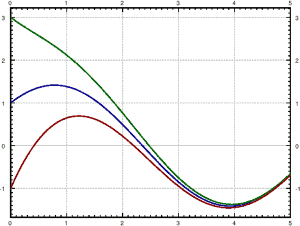
Table of contents:
1. First-order equations
2. Higher-order linear ODEs
3. Systems of ODEs
4. Fourier series and PDEs
5. More on eigenvalue problems
6. The Laplace transform
7. Power-series methods
8. Nonlinear systems
A. Linear algebra
Adoption:
Download:
(May 18th, 2026, version 6.11, 466 pages, approximately 4.1 MB download)
Buy paperback:
ISBN-13: 978-1706230236
ISBN-10: 1706230230
Note: It is print-on-demand so it should always be the
newest version, though in rare cases Amazon may send an older version if
they happened to have it in stock for some reason.
Web version:
Search:
Interactive Sage demonstrations:
YouTube course and slides (not yet complete):
Instructor resources:
Online homework (WeBWorK / Edfinity):
Discussion/Announcement forum:
Other instructor resources:
Translations, derivative versions, video lectures:
Source:
License:

Useful links:


