You have surely heard the story about the flap of a butterfly wing in the Amazon causing hurricanes in the North Atlantic. In a prior section, we mentioned that a small change in initial conditions of the planets can lead to very different configurations of the planets in the long term. These are examples of chaotic systems. Mathematical chaos is not really chaos—there is precise order behind the scenes. Everything is still deterministic. However, a chaotic system is extremely sensitive to initial conditions. This also means even small errors induced via numerical approximation create large errors very quickly, so it is almost impossible to numerically approximate for long times. This is a large part of the trouble, as chaotic systems cannot be in general solved analytically.
Take the weather, perhaps the most well-known chaotic system. A small change in the initial conditions (the temperature at every point of the atmosphere for example) produces drastically different predictions in a relatively short time, and so we cannot accurately predict weather. And we do not actually know the exact initial conditions. We measure temperatures at a few points with some error, and then we somehow estimate what is in between. There is no way we can accurately measure the effects of every butterfly wing. Then we solve the equations numerically, introducing new errors. You should not trust weather prediction more than a few days out. But we will see we can still get some information about a chaotic system on a longer time scale. In the context of weather, we can study the climate.
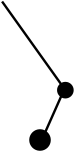
A simple example the reader can experiment with, and which displays chaotic behavior, is a double pendulum. The equations for this setup are somewhat complicated, and their derivation is quite tedious, so we will not bother to write them down. The idea is to put a pendulum on the end of another pendulum. The movement of the bottom mass will appear chaotic. This type of chaotic system is the basis for a number of office novelty desk toys. It is simple to build a version. Take a piece of string. Tie two heavy nuts at different points of the string; one at the end, and one a bit above. Now give the bottom nut a little push. As long as the swings are not too big and the string stays tight, you have a double pendulum system.
Subsection8.5.1Duffing equation and strange attractors
Let us study the so-called Duffing equation:
\begin{equation}
x'' + a x' + bx + cx^3 = C \cos(\omega t) .
\end{equation}
Here \(a\text{,}\)\(b\text{,}\)\(c\text{,}\)\(C\text{,}\) and \(\omega\) are constants. Except for the \(c x^3\) term, this equation looks like a forced mass-spring system. The \(c x^3\) means the spring does not exactly obey Hooke’s law (which no real-world spring actually obeys exactly). When \(c\) is not zero, the equation does not have a closed-form solution, so we must resort to numerical solutions, as is usual for nonlinear systems. Not all choices of constants and initial conditions exhibit chaotic behavior. Let us study
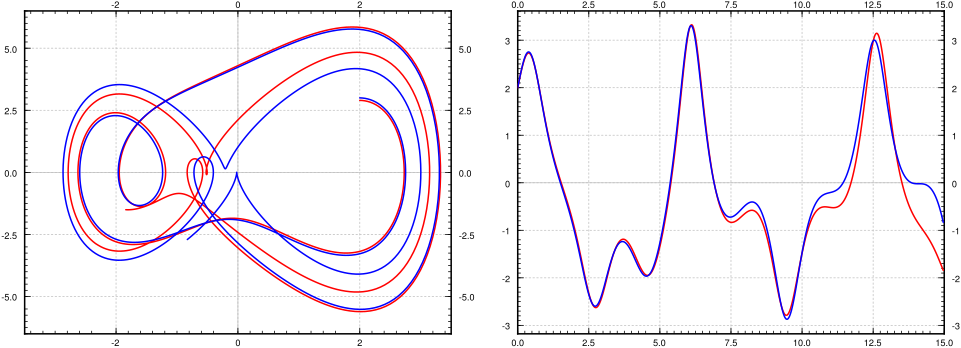
The equation is not autonomous, so we cannot draw the vector field in the phase plane. We can still draw trajectories, where \(y=x'\) as usual. In Figure 8.12, we plot trajectories for \(t\) going from 0 to 15 for two very close initial conditions \((2,3)\) and \((2,2.9)\text{,}\) and also the solutions in the \((x,t)\) space. The two trajectories are close at first, but soon diverge significantly. This sensitivity to initial conditions is precisely what we mean by the system behaving chaotically.
Figure8.12.On left, two trajectories in phase space for \(0 \leq t \leq 15\text{,}\) for the Duffing equation one with initial conditions \((2,3)\) and the other with \((2,2.9)\text{.}\) On right the two solutions in \((x,t)\)-space.
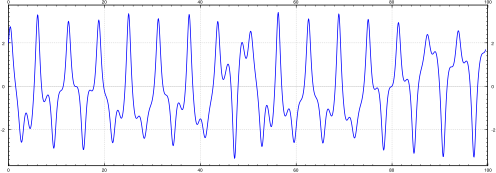
Let us consider the long-term behavior. In Figure 8.13, we plot the solution \(x\) with initial conditions \((2,3)\) for a longer period of time. It is hard to see any pattern in the shape of the solution except that it seems to oscillate, but each oscillation appears quite unique. Oscillation is expected due to the forcing term. We mention that to produce the picture accurately, a ridiculously large number of steps 2
In fact for reference, 30,000 steps were used with the Runge–Kutta algorithm, see exercises in Section 1.7.
were used in the numerical algorithm, as even small errors quickly propagate in a chaotic system.
It is very difficult to analyze chaotic systems, or to find the order behind the madness, but let us try to do something that we did for the standard mass-spring system. One way we analyzed the system is that we figured out what the long-term behavior was (not dependent on initial conditions). From the figure above, it is clear that we will not get a nice exact description of the long-term behavior for this chaotic system, but perhaps we can find some order to what happens on each “oscillation” and what these oscillations have in common.
. Instead of looking at \(t\) in a certain interval, we look at where the system is at a certain sequence of points in time. Imagine flashing a strobe at a fixed frequency and drawing the points where the solution is during the flashes. The right strobing frequency depends on the system in question. The correct frequency for the forced Duffing equation (and other similar systems) is the frequency of the forcing term. For the Duffing equation above, find a solution \(\bigl(x(t),y(t)\bigr)\text{,}\) and look at the points
As we are really not interested in the transient part of the solution, that is, the part of the solution that depends on the initial condition, we skip some number of steps in the beginning. For example, we might skip the first 100 such steps and start plotting points at \(t = 100(2\pi)\text{,}\) that is,
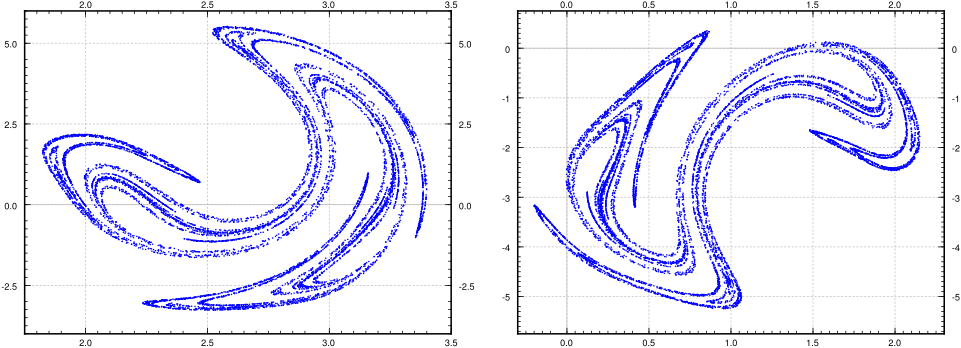
The plot of these points is the Poincaré section. After plotting enough points, a curious pattern emerges in Figure 8.14 (the left-hand picture), a so-called strange attractor.
Given a sequence of points, an attractor is a set towards which the points in the sequence eventually get closer and closer, that is, they are attracted. The Poincaré section is not really the attractor itself, but as the points are very close to it, we see its shape. The strange attractor is a very complicated set. It has fractal structure, that is, if you zoom in as far as you want, you keep seeing the same complicated structure.
The initial condition makes no difference. If we start with a different initial condition, the points eventually gravitate towards the attractor, and so as long as we throw away the first few points, we get the same picture. Similarly, small errors in the numerical approximations do not matter here.
An amazing thing is that a chaotic system such as the Duffing equation is not random at all. There is a very complicated order to it, and the strange attractor says something about this order. We cannot quite say what state the system will be in eventually, but given the fixed strobing frequency we narrow it down to the points on the attractor.
we obtain a slightly different attractor. The picture is the right-hand side of Figure 8.14. It is as if we had rotated, moved, and slightly distorted the original. For each phase shift you can find the set of points towards which the system periodically keeps coming back to.
Study the pictures and notice especially the scales—where are these attractors located in the phase plane. Notice the regions where the strange attractor lives and compare it to the plot of the trajectories in Figure 8.12.
This is like the Duffing equation, but with no \(x^3\) term. The steady periodic solution is of the form
\begin{equation}
x = C \cos (\omega t + \gamma) .
\end{equation}
Strobing using the frequency \(\omega\text{,}\) we obtain a single point in the phase space. The attractor in this setting is a single point—an expected result as the system is not chaotic. It was the opposite of chaotic: Any difference induced by the initial conditions dies away very quickly, and we settle into always the same steady periodic motion.
In two dimensions to find chaotic behavior, we must study forced, or non-autonomous, systems such as the Duffing equation. The Poincaré–Bendixson Theorem says that a solution to an autonomous two-dimensional system that exists for all time in the future either goes towards infinity, is periodic, approaches a loop, or perhaps goes towards a critical point. Hardly the chaotic behavior we are looking for.
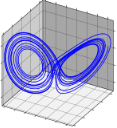
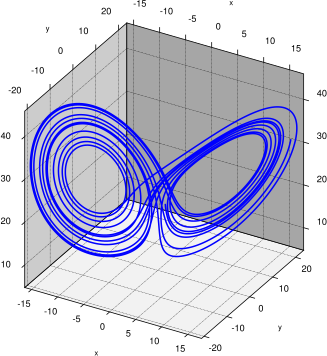
The Lorenz system is an autonomous system in three dimensions exhibiting chaotic behavior. See Figure 8.15 for a sample trajectory, which is now a curve in three-dimensional space.
The solutions tend to an attractor in space, the so-called Lorenz attractor. In this case, no strobing is necessary, the solution will tend towards the attractor set. Again we cannot quite see the attractor itself, but if we try to follow a solution for long enough, as in the figure, we get a pretty good picture of what the attractor looks like. The Lorenz attractor is also a strange attractor and has a complicated fractal structure. And, just as for the Duffing equation, what we want to draw is not the whole trajectory, but start drawing the trajectory after a while, once it is close to the attractor.
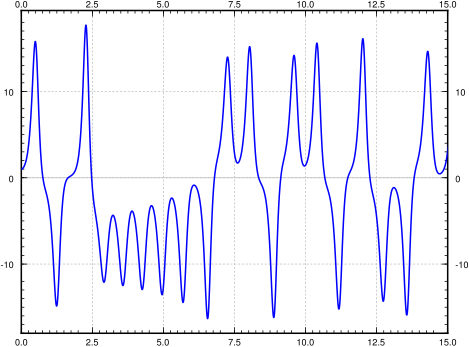
The path of the trajectory is not simply a repeating figure-eight. The trajectory spins some seemingly random number of times on the left, then spins a number of times on the right, and so on. As this system arose in weather prediction, one can perhaps imagine a few days of warm weather and then a few days of cold weather, where it is not easy to predict when the weather will change, just as it is not really easy to predict far in advance when the solution will jump onto the other side. See Figure 8.16 for a plot of the \(x\) component of the solution drawn above. A negative \(x\) corresponds to the left “loop” and a positive \(x\) corresponds to the right “loop”. On the other hand, while we cannot predict the weather, we can say something about the climate—the weather will be somewhere near the attractor.
Most of the mathematics we studied in this book is quite classical and well understood. On the other hand, chaos, including the Lorenz system, continues to be the subject of current research. Furthermore, chaos has found applications not just in the sciences, but also in art.
For the non-chaotic equation \(x''+2p x' + \omega_0^2 x = \frac{F_0}{m} \cos (\omega t)\text{,}\) suppose we strobe with frequency \(\omega\) as we mentioned above. Use the known steady periodic solution to find precisely the point which is the attractor for the Poincaré section.
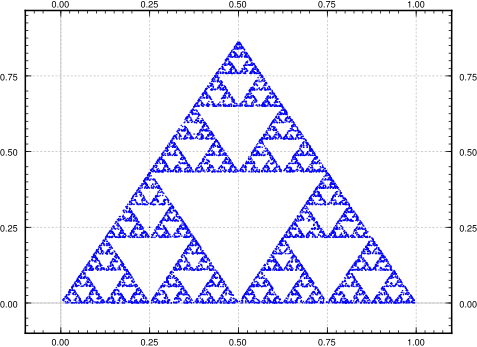
(project) A simple fractal attractor can be drawn via the following chaos game. Draw the three vertices of a triangle and label them, say \(p_1\text{,}\)\(p_2\) and \(p_3\text{.}\) Draw some random point \(p\) (it does not have to be one of the three points above). Roll a die to pick one of the \(p_1\text{,}\)\(p_2\text{,}\) or \(p_3\) randomly (for example 1 and 4 mean \(p_1\text{,}\) 2 and 5 mean \(p_2\text{,}\) and 3 and 6 mean \(p_3\)). Suppose we picked \(p_2\text{.}\) Let \(p_{\text{new}}\) be the point exactly halfway between \(p\) and \(p_2\text{.}\) Draw this point and let \(p\) now refer to this new point \(p_{\text{new}}\text{.}\) Rinse, repeat. Try to be precise and draw as many iterations as possible. Your points will be attracted to the so-called Sierpinski triangle. A computer was used to run the game for 10,000 iterations to obtain the picture in Figure 8.17.
(project) Construct the double pendulum described in the text with a string and two nuts (or heavy beads). Play around with the position of the middle nut, and perhaps use different weight nuts. Describe what you find.
(computer project) Use computer software (such as Matlab, Octave, or perhaps even a spreadsheet) to plot the solution of the given forced Duffing equation with Euler’s method. Plot the solution for \(t\) from 0 to 100 with several different (small) step sizes. Discuss.
Critical points: \((0,0,0)\text{,}\)\((6\sqrt{2},6 \sqrt{2}, 27)\text{,}\)\((-6 \sqrt{2},-6 \sqrt{2}, 27)\text{.}\) Linearization at \((0,0,0)\) using \(u=x\text{,}\)\(v=y\text{,}\)\(w=z\) is \(u' = -10u+10v\text{,}\)\(v'=28u-v\text{,}\)\(w'=-(\nicefrac{8}{3})w\text{.}\) Linearization at \((6 \sqrt{2},6\sqrt{2},27)\) using \(u=x-6\sqrt{2}\text{,}\)\(v=y-6\sqrt{2}\text{,}\)\(w=z-27\) is \(u' = -10u+10v\text{,}\)\(v'=u-v-6\sqrt{2}w\text{,}\)\(w'=6\sqrt{2}u+6\sqrt{2}v-(\nicefrac{8}{3})w\text{.}\) Linearization at \((-6 \sqrt{2},-6\sqrt{2},27)\) using \(u=x+6\sqrt{2}\text{,}\)\(v=y+6\sqrt{2}\text{,}\)\(w=z-27\) is \(u' = -10u+10v\text{,}\)\(v'=u-v+6\sqrt{2}w\text{,}\)\(w'=-6\sqrt{2}u-6\sqrt{2}v-(\nicefrac{8}{3})w\text{.}\)