We take a moment to discuss constant-coefficient linear homogeneous systems in the plane. Much intuition can be obtained by studying this simple case. We use coordinates \((x,y)\) for the plane as usual, and suppose \(P = \left[ \begin{smallmatrix} a & b \\ c & d \end{smallmatrix} \right]\) is a \(2 \times 2\) matrix. Consider the system
\begin{equation}
\begin{bmatrix} x \\ y \end{bmatrix} ' =
P \begin{bmatrix} x \\ y \end{bmatrix}
\qquad
\text{or}
\qquad
\begin{bmatrix} x \\ y \end{bmatrix} ' =
\begin{bmatrix} a & b \\ c & d \end{bmatrix}
\begin{bmatrix} x \\ y \end{bmatrix}
.\tag{3.3}
\end{equation}
The system is autonomous (compare this section to Section 1.6), and so we draw a vector field (see the end of Section 3.1). We will be able to visually understand this vectorfield and the solutions of the ODE in terms of the eigenvalues and eigenvectors of the matrix \(P\text{.}\) For this section, we assume that \(P\) has two distinct eigenvalues and two corresponding eigenvectors. We will also assume that \(P\) is nonsingular, that is, neither eigenvalue is zero.
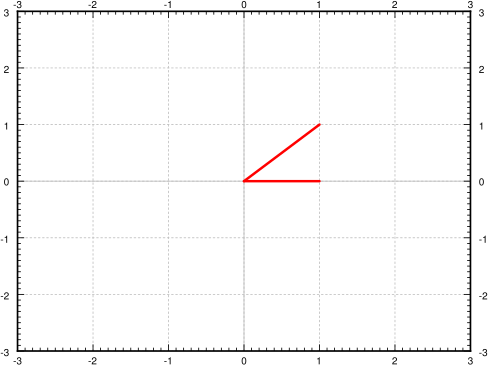
Case 1. Suppose that the eigenvalues of \(P\) are real and positive. We find two corresponding eigenvectors and plot them in the plane. For example, take the matrix \(\left[ \begin{smallmatrix} 1 & 1 \\ 0 & 2 \end{smallmatrix}
\right]\text{.}\) The eigenvalues are 1 and 2 and corresponding eigenvectors are \(\left[ \begin{smallmatrix} 1 \\ 0 \end{smallmatrix} \right]\) and \(\left[ \begin{smallmatrix} 1 \\ 1 \end{smallmatrix} \right]\text{.}\) See Figure 3.4.
Let \((x,y)\) be a point on the line determined by an eigenvector \(\vec{v}\) for an eigenvalue \(\lambda\text{.}\) That is, \(\left[ \begin{smallmatrix} x \\ y \end{smallmatrix} \right] = \alpha \vec{v}\) for some scalar \(\alpha\text{.}\) Then
\begin{equation}
\begin{bmatrix} x \\ y \end{bmatrix} '
=
P \begin{bmatrix} x \\ y \end{bmatrix}
=
P ( \alpha \vec{v} ) = \alpha ( P \vec{v} )
= \alpha \lambda \vec{v} .
\end{equation}
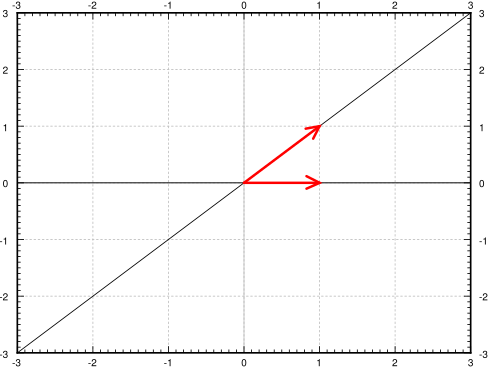
The derivative is a multiple of \(\vec{v}\) and hence points along the line determined by \(\vec{v}\text{.}\) As \(\lambda > 0\text{,}\) the derivative points in the direction of \(\vec{v}\) when \(\alpha\) is positive and in the opposite direction when \(\alpha\) is negative. We draw the lines determined by the eigenvectors and arrows on the lines to indicate the directions. See Figure 3.5.
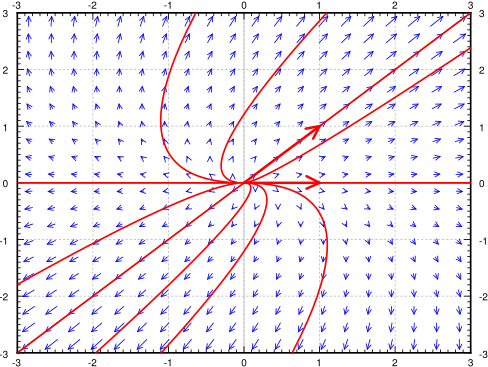
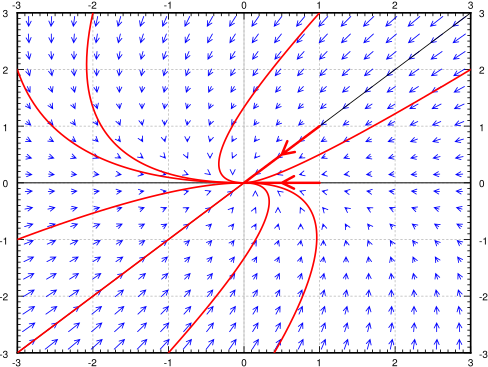
We fill in the rest of the arrows for the vector field, and we draw a few solutions. See Figure 3.6. The picture looks like a source with arrows coming out from the origin. Hence we call this type of picture a source or sometimes an unstable node.
Case 2. Suppose both eigenvalues are negative. For example, take the negation of the matrix from case 1, \(\left[ \begin{smallmatrix} -1 & -1 \\ 0 & -2 \end{smallmatrix} \right]\text{.}\) The eigenvalues are \(-1\) and \(-2\) and corresponding eigenvectors are the same, \(\left[ \begin{smallmatrix} 1 \\ 0 \end{smallmatrix} \right]\) and \(\left[ \begin{smallmatrix} 1 \\ 1 \end{smallmatrix} \right]\text{.}\) The calculation and the picture are almost the same. The difference is that the eigenvalues are negative and arrows are reversed. We get the picture in Figure 3.7. We call this type of picture a sink or a stable node.
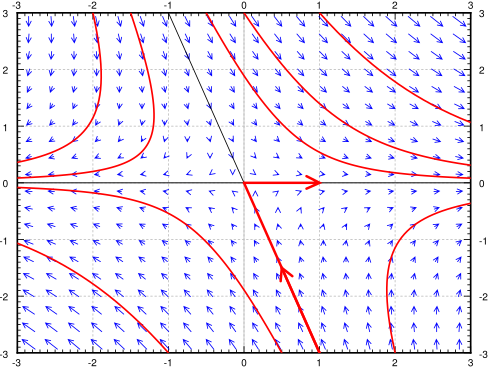
Case 3. Suppose one eigenvalue is positive and one is negative. For example, consider \(P = \left[ \begin{smallmatrix} 1 & 1 \\ 0 & -2 \end{smallmatrix} \right]\text{.}\) The eigenvalues are 1 and \(-2\) and corresponding eigenvectors are \(\left[ \begin{smallmatrix} 1 \\ 0 \end{smallmatrix} \right]\) and \(\left[ \begin{smallmatrix} 1 \\ -3 \end{smallmatrix} \right]\text{.}\) We reverse the arrows on the line corresponding to the negative eigenvalue and we obtain the picture in Figure 3.8. We call this picture a saddle point.
For the next three cases, we will assume the eigenvalues are complex. In this case the eigenvectors are also complex and we cannot just plot them in the plane.
Case 4. Suppose the eigenvalues are purely imaginary, that is, \(\pm ib\text{.}\) For example, let \(P =
\left[ \begin{smallmatrix} 0 & 1 \\ -4 & 0 \end{smallmatrix} \right]\text{.}\) The eigenvalues are \(\pm 2i\) and corresponding eigenvectors are \(\left[ \begin{smallmatrix} 1 \\ 2i \end{smallmatrix} \right]\) and \(\left[ \begin{smallmatrix} 1 \\ -2i \end{smallmatrix} \right]\text{.}\) Consider the eigenvalue \(2i\) and its eigenvector \(\left[ \begin{smallmatrix} 1 \\ 2i \end{smallmatrix} \right]\text{.}\) The real and imaginary parts of \(\vec{v} e^{2it}\) are
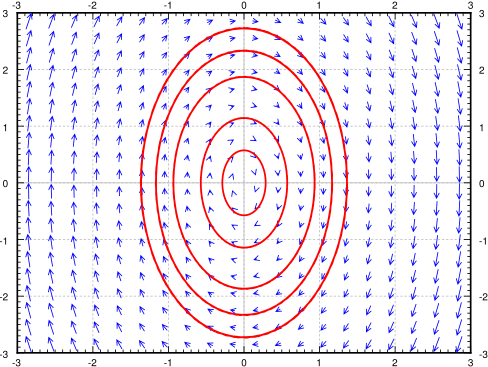
We can take any linear combination of them to get other solutions, which one we take depends on the initial conditions. Now note that the real part is a parametric equation for an ellipse. Same with the imaginary part and in fact any linear combination of the two. This is what happens in general when the eigenvalues are purely imaginary. So when the eigenvalues are purely imaginary, we get ellipses for the solutions. This type of picture is sometimes called a center. See Figure 3.9.
Case 5. Now suppose the complex eigenvalues have a positive real part. That is, suppose the eigenvalues are \(a \pm ib\) for some \(a > 0\text{.}\) For example, let \(P =
\left[ \begin{smallmatrix} 1 & 1 \\ -4 & 1 \end{smallmatrix} \right]\text{.}\) The eigenvalues turn out to be \(1\pm 2i\) and eigenvectors are \(\left[ \begin{smallmatrix} 1 \\ 2i \end{smallmatrix} \right]\) and \(\left[ \begin{smallmatrix} 1 \\ -2i \end{smallmatrix} \right]\text{.}\) We take \(1 + 2i\) and its eigenvector \(\left[ \begin{smallmatrix} 1 \\ 2i \end{smallmatrix} \right]\) and find the real and imaginary parts of \(\vec{v} e^{(1+2i)t}\) are
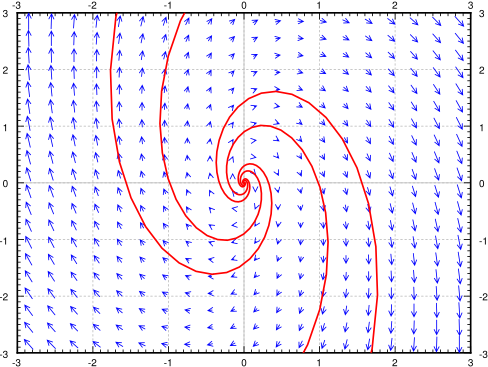
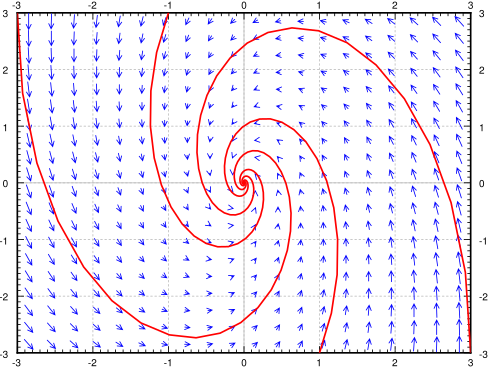
Note the \(e^t\) in front of the solutions. The solutions grow in magnitude while spinning around the origin. Hence we get a spiral source. See Figure 3.10.
Case 6. Finally suppose the complex eigenvalues have a negative real part. That is, suppose the eigenvalues are \(-a \pm ib\) for some \(a > 0\text{.}\) For example, let \(P =
\left[ \begin{smallmatrix} -1 & -1 \\ 4 & -1 \end{smallmatrix} \right]\text{.}\) The eigenvalues turn out to be \(-1\pm 2i\) and eigenvectors are \(\left[ \begin{smallmatrix} 1 \\ -2i \end{smallmatrix} \right]\) and \(\left[ \begin{smallmatrix} 1 \\ 2i \end{smallmatrix} \right]\text{.}\) We take \(-1 - 2i\) and its eigenvector \(\left[ \begin{smallmatrix} 1 \\ 2i \end{smallmatrix} \right]\) and find the real and imaginary parts of \(\vec{v} e^{(-1-2i)t}\) are
Note the \(e^{-t}\) in front of the solutions. The solutions shrink in magnitude while spinning around the origin. Hence we get a spiral sink. See Figure 3.11.
We summarize the behavior of linear homogeneous two-dimensional systems given by a nonsingular matrix in Table 3.1. Systems where one of the eigenvalues is zero (the matrix is singular) come up in practice from time to time, see Example 3.1.2, and the pictures are somewhat different (simpler in a way). See the exercises. When the eigenvalues are real and repeated, the analysis is a little bit more difficult and we have not yet covered how to solve such systems, but the idea is roughly the same—a repeated positive eigenvalue means a source and a repeated negative eigenvalue means a sink.
What happens in the case when \(P =
\left[ \begin{smallmatrix} 1 & 1 \\ 0 & 1 \end{smallmatrix} \right]\text{?}\) In this case the eigenvalue is repeated and there is only one independent eigenvector. Draw and describe the vector field.
What happens in the case when \(P =
\left[ \begin{smallmatrix} 1 & 1 \\ 1 & 1 \end{smallmatrix} \right]\text{?}\) Draw the vector field. Does this look like any of the pictures we have drawn?
Which behaviors are possible if \(P\) is diagonal, that is, \(P = \left[ \begin{smallmatrix} a & 0 \\ 0 & b \end{smallmatrix} \right]\text{?}\) You can assume that \(a\) and \(b\) are not zero.
Take the system from Example 3.1.2, \(x_1'=\frac{r}{V}(x_2-x_1)\text{,}\)\(x_2'=\frac{r}{V}(x_1-x_2)\text{.}\) As we said, one of the eigenvalues is zero. What is the other eigenvalue, how does the picture look like, and what happens when \(t\) goes to infinity.
a) Two eigenvalues: \(\pm \sqrt{2}\) so the behavior is a saddle. b) Two eigenvalues: \(1\) and \(2\text{,}\) so the behavior is a source. c) Two eigenvalues: \(\pm 2i\text{,}\) so the behavior is a center (ellipses). d) Two eigenvalues: \(-1\) and \(-2\text{,}\) so the behavior is a sink. e) Two eigenvalues: \(5\) and \(-3\text{,}\) so the behavior is a saddle.
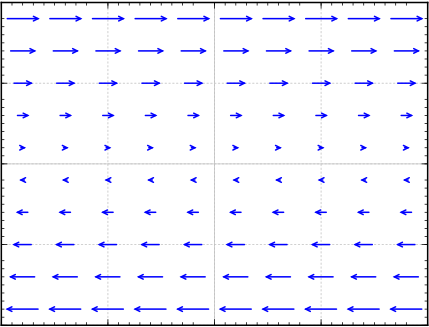
Take \(\left[ \begin{smallmatrix}
x \\ y
\end{smallmatrix}\right] '
=
\left[ \begin{smallmatrix}
0 & 1 \\ 0 & 0
\end{smallmatrix}\right]
\left[ \begin{smallmatrix}
x \\ y
\end{smallmatrix}\right]\text{.}\) Draw the vector field and describe the behavior. Is it one of the behaviors that we have seen before?
The solution does not move anywhere if \(y = 0\text{.}\) When \(y\) is positive, the solution moves (with constant speed) in the positive \(x\) direction. When \(y\) is negative, the solution moves (with constant speed) in the negative \(x\) direction. It is not one of the behaviors we saw. Note that the matrix has a double eigenvalue 0 and the general solution is \(x = C_1 t + C_2\) and \(y = C_1\text{,}\) which agrees with the description above.